Embark on a thrilling 4D/3N Amazon Jungle Trip from Puerto Maldonado.
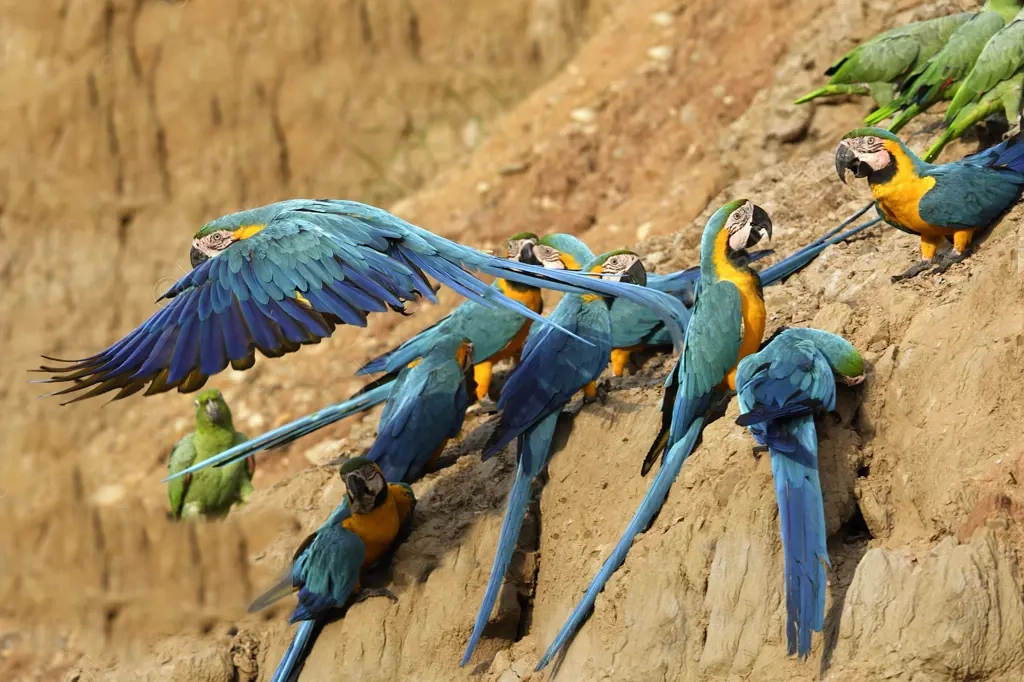
Amazon jungle Trip – Tambopata Rainforest . (Macaw Clay Lick ) once enough parakeets have built up in the trees of the area of the Amazon Jungle trip , and they are sure that they have scouted the area well for potential predators, such as ocelots, raptors and snakes, they start to work their way through the vegetation. There is a lot of nervous activity, with all the
birds waiting for one brave individual to land on the clay surface first. Once this has happened, within minutes hundreds of birds descend onto the clay surface, turning it from red-brown to green,
Galeria de fotos
SUMMARY:
Amazon Jungle Trip :Discover the Wonders of the Madre de Dios Jungle
Nestled in the heart of the Amazon Jungle Trip, the Madre de Dios Department in Peru is a gateway to one of the world’s most biodiverse ecosystems. Just a short distance from the vibrant city of Puerto Maldonado, lies a hidden paradise – the Amazon Peru Reserve. This breathtaking destination is a must-visit for travelers seeking an authentic adventure amidst nature’s most extraordinary beauty.
OVERVIEW
DAY 1: PUERTO MALDONADO
Arrival and Preparation
A representative picks up guests from Puerto Maldonado airport or bus station and transfers them to the Amazon Jungle Trip office. Guests store unnecessary belongings and purchase any necessities.
Boat Ride to Inotawa Lodge
Guests board a boat for a scenic 2-hour ride along the Tambopata River. They enjoy lunch onboard and observe the diverse flora and fauna along the riverbanks.
Arrival at Lodge
Upon arrival at the lodge, guests check in and receive a briefing from their tour guide. In the afternoon, they explore the surrounding jungle on a guided walk, observing birds, trees, and wildlife.
Optional Night Walk
Guests can join a night walk with the tour guide to spot nocturnal animals.
Dinner and Overnight
The lodge serves dinner, followed by a restful night in comfortable accommodations.
DAY 2: AMAZON JUNGLE TRIP – MACAW’S CLAY-LICK
Early Morning Excursion
Guests wake up early for breakfast, then board a boat to Collpa La Torre, a clay-lick, where they observe macaws, parrots, and other wildlife.
Wildlife Observation
After watching the clay-lick spectacle, guests return to the lodge for lunch. They then head out for fishing on the Tambopata River.
Optional Night Activity
Guests may choose to join a night caiman observation excursion on the river.
Dinner and Overnight
The lodge serves dinner, followed by a relaxing evening in the jungle.
DAY 3: TAMBOPATA TRES CHIMBADAS LAKE
Exploration of Tres Chimbas Lake
After breakfast, guests board a rowing boat and hike to Tres Chimbas Lake, where they observe giant river otters and a variety of bird species.
Fishing and Bamboo Forest Exploration
Guests fish for piranhas and explore a nearby bamboo forest, where they observe rare bird species and migratory birds.
Return to Lodge
In the evening, guests return to the lodge, enjoying the sounds of the jungle and possibly spotting wildlife.
Dinner and Overnight
The lodge serves dinner, followed by a peaceful night surrounded by nature.
DAY 4: BACK TO PUERTO MALDONADO
Return Journey
After breakfast, guests board a motorboat for the return trip to Puerto Maldonado, enjoying the scenic views along the Tambopata River.
Transfer to Puerto Maldonado
Upon arrival in Puerto Maldonado, guests transfer to the Amazon Jungle Trip office to collect their belongings.
DETAILED ITINERARY:
Amazon Jungle trip
Stepping into the Amazon Peru Reserve is like entering another world. Vibrant, untouched, and brimming with life, this reserve is a sanctuary for wildlife enthusiasts, nature lovers, and adventure seekers alike. As you venture through the lush greenery, you’ll be enveloped by the sounds of the rainforest, from the calls of exotic birds to the hum of jungle insects. The Amazon here is not just a place—it’s an experience.
- Length: 4 Days/3 Nights
- Location: Southern Peru, Madre de Dios Department, Puerto Maldonado
- Type of service: Private or Group
- Start Point : Pick-up from the Hotel/Aiport or Bus Terminal in Puerto Maldonado
- Ending Point: Drop off the Hotel/Airport or Bus Terminal in Puerto Maldonado
- Departure: Every Day
- Activities: Puerto Maldonado Sunrise and Sunset Photography, Adventures –
Tambopata Rainforest Tours , La Torre Clay-Lick, Tres Chimbadas Lake, daily and night walking, piranha fishing, camping
- Altitude: 182 – m.a.s.l.
- Best time to visit:March – November
- Accomodation : 3 night in Our Lodge rivate Room with Mosquito Nets, Private Showers and Bathrooms .
- Meals: 3 Breakfast /3 Lunch /3 Dinner
- Tour Guides Professional bilingual local guide (well-equipped with guiding gear)
- Minimum of participants: 2
- Maximum of participants: 8
OUR SERVICES:
PHOTO GALLERY OF THE SHELTER:
Frequently Asked Questions:
TRAVEL GUIDE:
Amazon Jungle trip Mammals :
Amazon Jungle Trips :Comparisons with mammalian geophagy to date, no study has attempted to map mammalian geophagy at a landscape level in South America. Most studies focus on a few species at a small number of sites However, the literature suggests the patterns of mammalian of the Amazon Jungle Trips may mirror those of avian geophagy with some simple differences. In general, mammalian geophagy is apparently more common and more widespread in Amazon Jungle Trips because mammals are less restricted as to the types of sites they can use so (parrots use mostly river banks sites while mammals use river banks along with areas in the forest) of the Amazon Jungle Trips.
Mammals which remove more soil than birds may also
be more capable of excavating new sites and maintaining old sites free of vegetation. Mammals (including tapir Tapirs terrestrial, collared peccary Tayassu tajacu, red brocket deer Mazama americana, red howler monkey Alouatta seniculus, brown agouti Dasyprocta variegate, southern Amazonian red squirrel Sciurus spadiceus and capybara
Hydrochoerus hydrochaeris) have been observed Feeding at several parrot clay licks in southeastern Peru In addition, recent reports on bat geophagy are in the area where parrot of the Amazon Jungle Trips is observed most, suggesting that characteristics of the soil appear to be attractive to both mammals and birds.
A review of primate Amazon Jungle Trips in South America highlights it’s occurrence in the Amazon Jungle Trips, with relatively few reports from the Brazilian Atlantic forest Spider monkey Ateles spp. in Ecuador and Peru came to
the ground more often to eat soil, rotten wood or territorial compared to four sites in Central America where sodium is higher and we would predict geophagy to be lower. The geophagy at ant heaps has been observed in the coastal species such as masked-titi monkeys Callicebus personatus and red-handed howler monkeys Alouatta belzebul. Sodium was not considered the Cause of geophagy, although in neither of these reports could geophagy considered to be regular. Moustached tamarin Saguinus mystax from Peru (Heymann and Hartmann 1991) and red howler monkey Alouatta seniculus from Colombia (Izawa 1993) have also been recorded eating soil in the western Amazon.
Sodium is the most common reason cited for geophagy worldwide, so future studies could test the hypotheses proposed here for birds,using regular geophagy by mammals.
Attempts to distinguish between causes
of ‘‘regular geophagy’’ and ‘‘incidental geophagy’’ may be enlightening. The distribution of parrot claylicks across South America has important community and conservation implications for parrot populations.
The western Amazon has until now been little impacted by anthropogenic change but now faces increasing infrastructure development with associated conservation implications, including colonisation, deforestation and forest
fragmentation. Sites in southeast Peru recording up to 20 parrot species are an anomaly in the trend of decreasing parrot species richness across South America from the northeast to southwest .
If the presence of geophagy sites aid the persistence of marginalized species in this region remains to be seen, but the impact of increased disturbance on parrot activity at riverside Amazon Jungle Trips sites needs to be investigated.
The distribution of parrot clay licks across South America lends strength to the theory that the need for sodium results in one of the western Amazon Jungle Trips ’s most interesting ornithological phenomena, yet much still needs to be understood on the factors, both human and ecological, that influence the parrot of the Amazon Jungles across
South America.